Showing posts with label Opinions. Show all posts

Thursday, November 13, 2008

Guru Dutt : Genius?(Songs & Cinematography) - 3


Continuing from


Song Picturisations

Indian cinema has long been accused of looking westward for inspiration, both in subject matter and in technique, a charge that is not completely baseless.

However, despite all the inspiration the truth is that our stamp is uniquely ours. If one dwells for moment on what distinguishes Indian main-stream cinema from that of the rest of the world the answer flashes in bold letters. Songs!. The use of music as a part of the narrative is unique to our cinema. The west has it’s musicals but they are nothing like our musicals. For the west music is a form of recreation and a tool for intellectual expression. For us, music is all that and much more. It is a form of expressing the innermost stirrings of the soul, of a pathos that is deep and unfathomable and of a joy that is unmitigated. Basically music in our cinema expresses all that words and outward expressions cannot. Film-maker Chetan Anand very telling summarized this feeling saying ‘Dialogues are like the outer-covering, the clothes a person wears. Music is the like the inner-core, the soul of a person. It is an indispensable tool for cinema’.

Great film-makers over the times have recognized this tool and used it to enhance the emotional content of their films. There are many such moments in Indian cinema that would not have been possible without songs. Can you imagine the climax of ‘Bandini’ without the soul-searing ‘Mere saajan hain us paar’ or a depiction of Radha’s struggles in Mother India without ‘Duniya mein hum aaye hain’? Guru Dutt holds a place of pride in this elite club of great musical moments.

In an era where an entire 4 minute song could be shot with the lead actors sitting in one place and staring in the same direction(and that is infinity!), Dutt infused his picturisations with innovation and imagination. The talent was apparent early on. From the first film 'Baazi' where Geeta Bali's dances were shot with elaborate camera movements and evolved choreography way down to SBAG Guru Dutt was always on top of things. In ‘Jaal’ the variety is out for all to see. There is the mellowness of dusk in ‘Pighala hai sona’ where the camera rocks gently with the boats and capturing the hues of twilight in black and white, the inspiring ‘Zor lagake haiyya’ where the mundane act of pulling a fishnet out water is used as a focal point to weave an entire song around, the choral folk dance of ‘Door kahin ek taara - Maria’ and the innovative picturisation of ‘De bhi chuke hum dil nazrana dilka’ using tight-closeups with the lead characters swinging on the branches of a tree (drives home the point that our ancestors were apes!).

It was also common to see songs picturised on characters other than the lead players. Passers-by, vendors, halkers, construction site workers, anyone could pitch. In that sense the song picturisation was very natural. It is more likely a street singer would burst into a song at the most opportune moment (e.g Ab to ji hone laga) rather than a character who is pre-occupied with important thoughts and emotion. Background songs have always been a very powerful tool for taking the narrative forward.

Like Raj Kapoor, the symbolism in Guru Dutt’s songs is deep. The Christ like resurrection of the poet in ‘Pyaasa’ is symbolized by the iconic shot in of Guru Dutt framed by backlight in ‘Yeh duniya agar mil bhi jaaye'. The indifference of the world to the inner beauty of the poet is tellingly captured by oblivious boot trampling the metaphorical bee in it's uncaring stride ahead, in ‘Yeh hanste hue phool’.

In Guru Dutt’s songs, it was not only the concept but the execution that was innovative as well. Dutt had spent his earlier years in Uday Shankar’s troupes and rhythm was inbuilt in his system. In his cinema the shot compositions, the trolley movements, the lighting and the characters all seem to be move to a sub-aural symphony. This observation was confirmed by his cinematographer, VK Murthy, who admitted in an interview that they would try to cut their shots in rhythm with the beat-cycle of the song! That subtle ode to the rhythm runs through all Guru Dutt films.

Cinematography

The topic of song picturisation leads us to it's natural ally - cinematography, for which Dutt is widely celebrated. The cinematography in Guru Dutt’s films was undoubtedly the high point of his art. Dutt’s treatment of his subjects has an Oscar Wildesque irony to it. Like the 17th century writer, Dutt was extremely lyrical, deeply romantic and intensely poignant. His frames are rich and expressive and extensive use of tight close-up shots (a pioneering technique) helped his actors get intimate with the audience.

The tonal quality of Dutt's frames is rich, intense and is so replete with details of light and shade that one has no choice but to invoke the hackneyed 'poetry on celluloid' phrase. It truly is just that. I go further to say that it is a moving collection of paintings. A good litmus test to verify the truth in my observations would be to pause any frame in any of his films and observe the framing. You can print it out and hang it up on the wall. This greatness, ofcourse could not have been achieved without the genius of VK Murthy, his comrade in arms.

The examples are numerous, esp. in the song picturisations. 'Aaj sajan mohe ang lagalo' is an oft quoted, yet stunning example of Dutt's use of cinematography for mood creation. The brightness in 'Chori Chori Meri Gali', depicts the light and joyous mood of the characters. The dark and despondant hues of 'Jinhe naaz hai hind par'. 'Sakiya aaj mujhe' is another example of clever lighting where the lead dancer Minoo Mumtaz is bathed in bright light and the chorus remains swathed in the shadows.

Observing the fim-maker's repertoire down the ages, an interesting trait comes to light - The influence of noir in his cinematography. The enigmatic play of light and shade typified by the noir genre shows a strong presence in Guru Dutt's lighting choices. Even in situations and films that were far placed from noir, he showed a propensity to employ this technique of light and shade . An interesting example to demonstrate this trait would be the college reunion scene in 'Pyaasa'. The setting is a large auditorium with a gathering of students. A setting like this expects bright lighting esp. on the stage. Yet, in the song 'Tang aa gaye hain kashmakashe zindagi se hum' we see a lot of shadows. Shadows on the face of the poet reciting his poem on stage, on that of his ex-lover and her husband. It is as if through the use of lighting in this setting Dutt is trying to convey that the events of the past continue to cast a shadow on the present. Every person in the auditorium has a past lurking in the shadows. Even though the mood of such a setting is exuberant, through his lighting he has infused a sense of sombreness. This trait repeats in many other places, where there seems to be conscious choice to use shadows in settings that are typically brightly lit.

On the flip side, it is interesting to note that Dutt faced flak for the same visual lushness that we celebrate today. Like Sanjay Leela Bhansali is criticised for his opulent sets, in his times Dutt faced the same criticism. Critics of the era were of the opinion that the richness in his frames distracted the user from the main storyline!

The fact that Guru Dutt was under-appreciated in his life-time has no disputers. But did we over-c0mpensate in the later years by giving him a crown too big for his head? As we wind off, one is tempted to ask again ‘Was Guru Dutt truly a genius?’. The answer to this question be can be summed up in Oscar Wilde’s extremely insightful self-evaluation

‘I put all my genius into my life; I put only my talent into my works.’


---------------------------------------------------
Concluded

Note :

* - The film 'Sahib Bibi Aur Ghulam' is officially credited to Abrar Alvi, yet we work with the assumption that Guru Dutt as the producer would have had some kind of input into the character development. That he worked on the song picturisations in the films not directed by him is a documented fact.

Poll Results


HOW WOULD YOU RATE GURU DUTT?


Appendix - Videos


The videos in this section demonstrate some of the points discussed in the main article


Video : Influence of Noir in lighting - Pyaasa college reunion scene


Video : Pioneering use of tight-closeups - De Bhi Chuke (Jaal)


Video : Lyricsm in camera movements and outdoor photography - Pighala Hai Sona (Jaal)


Video : User of central motif to weave song picturisation (sarees)


Chal Diya Banda Nawaaz (Mrs and Mrs 55)


Video : User of central motif to weave song picturisation (Pulling out a fishing net)


Zor Lagaake Haiyya (Jaal)


Video : Mood creation through use of light and shade
Aaj Sajan Mohe Ang Lagalo (Pyaasa)


Video : Clever use of lighting in Sahib Bibi Aur Ghulam - Saakiya Aaj Mujhe


Video : Dark Despondant mood and beautiful framing - Jinhe Naaz Hai Hind Par(Pyaasa)


Video : Imginative shots of Waheeda amongst the the pillars - Jaane Kya Tune Kahi (Pyaasa)


Video : Desi Noir in Babuji Dheere Chalna (Aar Paar) (note the sense of mystery created by keeping the dancer in shadows)


Video : Songs picturised on extras and bit role players - Mohabbat Kar Lo(Aar Paar)


Wednesday, November 12, 2008

Guru Dutt : Genius? (Subjects) - 2


Subjects and Characterizations

The grays in Guru Dutt’s cinema deliciously mellowed the starkness of the black and white era


The main subjects that Indian cinema explored in the 50s and early 60s were strongly social in nature. Idealism was in the air and despite the low rumblings of discontent; films were essentially bright in the eyes. All significant film makers of the time - V Shantaram, Bimal Roy, Raj Kapoor, Navketan, Mehboob Khan etc. were wedded to social causes. In this context it is interesting to explore Guru Dutt's choice of subjects. We notice that he did little sermonizing. The only film where he takes a strong moral stance is surprisingly a regressive one. The satire of Mr and Mrs 55 was a comment on the new divorce law passed that year. The film albeit delightful, endorses the view that the ultimate place of the woman, however ‘modern’ is at the feet of her husband. For a man whose wife and mother were both were career women, this comes as a mild surprise. But then seeing the ultimate state of his marriage... maybe not!

However beyond Mr and Mrs 55 Guru Dutt's subjects were mostly non-judgmental. He seemed to have been magnetically drawn towards exploring flawed characters, the ones that floated between the black and white ends of the spectrum. In an era that celebrated human infallibility in the face of extreme adversity, that was certainly a trailblazing trait (albeit on a trail less tramped). Kagaz Ke Phool, as a serious self-portrait, remains a pioneer and the true flag-bearer of its genre. Years later Raj Kapoor attempted something similar with ‘Mera Naam Joker’, (another film accused of being self-indulgent), but his subject area was sufficiently far-placed from the world of cinema ensuring Kagaz Ke Phool kept it’s unique position in the history of mainstream cinema.

Dutt’s lead characters usually had their internal demons to fight and more often than not, they succumbed to them. The line drawn between the hero and the villain, the heroine and the vamp was porous. Characters flitted from one side to the other. The grays in Guru Dutt’s cinema deliciously mellowed the starkness of the black and white era. Dev Anand’s ‘Tony’ in “Jaal’, Geeta Bali in ‘Baazi’, Mala Sinha in ‘Pyaasa’, Vijay in ‘Pyaasa’, Suresh in ‘Kagaz Ke Phool’ and the most memorable of them all ‘Chhoti Bahu’ in Sahib Bibi aur Ghulam. Here was central character that was stubborn, uncompromising and rebellious yet vulnerable, passionate and devoted. She battled her fate using all the wrong moves, yet battled with valor. By killing her before she could be consumed by her own demons, Dutt put a halo around her head and it can be argued succumbed to the pressure to deify the character. Despite that it would not be hyperbole to say that Chhoti Bahu is a high water-mark in the art of character shading for mainstream cinema. **(see note)

In addition to the lead characters is can be noted that he created many memorable roles for supporting artists as well, notably Johnny Walker. On the flip side, his films and their stories are often accused of being juvenile and under-developed. Kagaz Ke Phool, despite the brilliant treatment is good only in parts. Even though the lead characters or the 'inner world' of the protagonist are well fleshed out, Guru Dutt's view of the 'outer' world was often replete with clichés. His films would have been far more interesting, if these characters had sympathetic undertones as well.

Take for example his brothers in ‘Pyaasa’. They are single dimensionally black. If the director had explored the conflict of the outer world which wants to help but cannot work with the waywardness of the poet it would have put the entire effort a couple of notches above it's current perch. Similarly in KKP, he gives no voice to the wife. There is no exploration of the internal battles that the spouse of an intensely creative person may have had to fight. It is common wisdom that it is not easy to be wedded to an achiever, esp. if he is an artist. The film industry has many such suffering spouses to espouse as an example (Krishna Raj Kapoor being most legendary of those). Yet Dutt chose to take the safe path of coloring the wife in unrelenting black.

To sum up it can be said that characterization was an area in which Guru Dutt attempted to break the mould, displayed sparks of genius and created many memorable characters in the wake. But at the end of the day, he could not carry it to a depth that could truly bracket his work as path-breaking.


To be concluded in part 3

Originally published at the Passion for Cinema blog at this link


Complete Article


See Also


Monday, October 13, 2008

Guru Dutt: Genius? (Introduction) - 1

At the outset let me lay out my disclaimers bold and clear. I am not a journalist, I am not a film critic and I am not a student of cinema. And however much I would have loved to, I never took a course on film appreciation either. Hence my opinions are all the unfettered rambling of an average film-goer and are based purely on instinct and observation.


The month of October marks the death anniversary of Guru Dutt. It was on 10th of October 1964 that the sensitive actor-director abandoned life in a late night over-dose of sleeping pills. Guru Dutt Shivshankar Padukone or Guru Dutt as he is better known has been widely acknowledged as a path-breaking genius who gave Indian Cinema some of its genre defining classics.

The Burden of Genius
Genius.. it is a mantle that sits heavy on the shoulder it chooses to adorn. Not only for the restlessness and turmoil that is inherent to its constitution but also for the back-bending load of myths and legends that the world tends to heap on it. Guru Dutt's shoulder has been exceptionally burdened, with the legends of his genius and with the myths of his checkered life.

His was a life that chillingly imitated art, its own art….

I have often wondered how much of the world's evaluation of artists like Guru Dutt is colored by the tragic nature of their life stories. Would KL Saigal have been as big a legend as he is if he had lived till his voice starting faltering, a la Lata Mangeshkar? Or conversely imagine if Lata had not lived beyond the 1970s (may God bless her with a long life!), I daresay her legend would have surpassed even that of Miyan Tansen. On second thoughts, maybe not… The legend of Tansen after all is fuelled by imagination and in today's age live recordings ensure that imagination does not have as free a run. Yet, it is suffice to say the myth of Lata Mangeshkar would have been far greater than Lata Mangeshkar herself.

In similar vein, Guru Dutt's myth has been largely fuelled by his life story. It is difficult for even the most objective reviewer to sit through 'Jaane woh kaise log the' and not associate it with his checkered love life, or to watch a broken director slump into eternal sleep in Kagaz Ke Phool and not think his suicide a couple of years later. The critical opinion on Guru Dutt has witnessed a maniacal swing over the decades. From the times when his films were written off as pieces of self-indulgent celluloid trash to the times today when even his lesser films are heaped with superlatives, the pendulum has only seen the extremes. In such circumstances the truth and hyperbole often mesh into one single gooey mix making it difficult to navigate the true strengths and weakness of an artist.

Even though world regularly doles it out like easy alms, the truth is that genius needs to be acknowledged with care. Talent and genius are as similar as innovation and invention. Not every great talent is a genius. It is a good practice to sometimes stand back and question genius, sacrilegious as it many seem. It is almost always an eye-opening exercise. Thus here is that attempt to look at Guru Dutt the artist, without letting the legend of Guru Dutt color the mission.

Contribution
Guru Dutt contributed to Indian cinema in the capacities of an actor, director, producer, choreographer and writer. While his entry into the film world was as a choreographer in the film 'Lakhrani', his output as an actor/director/producer is his real claim to fame. Film historians largely remember Dutt for spear-heading the noir movement in Indian cinema, for pioneering works in the field of cinematography, for his sensitive performances and mostly for the lyrical treatment of all the subjects that he chose to explore.

Let us examine each of these roles in some detail

Actor
As an actor, Guru Dutt acted in about 16 films, most of them for directors other than himself. His acting career was a product of frustration. Tired of trying to get Dev Anand, (his lead actor of his earlier films) to abandon his mannerisms and skeptical of pushing him too hard and ruining their friendship, Dutt decided to don the greasepaint himself. It is a record that for all his films, he had another actor in mind before he took on the role himself. Being an actor by compulsion, he never really excelled in the craft. His performances can be rated as adequate at best. He did well with the brooding roles that immortalized him however it can be argued that films like 'Baaz.' 'Aar Paar' and 'Mrs and Mrs 55' would have benefited with a more suitable actor(read extrovert) playing the lead role. One has to admit that acting was not where Guru Dutt's genius lay. We need to turn to his role as a director to justify the accolades heaped upon him.

Noir
As a director, Guru Dutt is largely identified with his semi-autobiographical brooding classics 'Pyaasa' and 'Kagaz ke Phool' and over the years they have come to be the brand ambassadors of his cinema. However any half-serious student of cinema also knows that this characterization is not completely accurate. Dutt's repertoire boasts of a decent variety of genres. There is the swashbuckling high sea drama (Baaz), the dark love story(Jaal), the social satire (Mr and Mrs 55) and most prolifically the desi noir (Baazi, Jaal, Aar Paar).

Noir was introduced to India in the early 50s. Even though this genre evolved in the Hollywood of the 1940s, it was not before post-independence that Indians found a social context for its adaptation. Sangram (1950) was one of the first few films that ventured into the territory. However it was Guru Dutt's 1951 debut -Baazi that is best remembered for blowing the bugle of noir in India.. The birth pangs of a newly independent nation saw a large scale migration to cities and young-men placed out of their social context and protection often took to crime in desperation. These films introduced a sympathetic outlook towards this underdog which was a marked digression from upright and moralistic stance of pre-independence India.

It was legendary actor Balraj Sahni who co-scripted Baazi along with Guru Dutt. The film admirably entwined the song-dance format into a genre that is genetically dark and brooding. It can be argued that the elements of noir stayed with Guru Dutt long after he moved onto other subjects, particularly in the lighting of his shots. However, despite the memorable output and pioneering adaptation, Dutt's contribution to the noir movement was essentially in the successful 'parathasizing' of the pancake, a skill that Indian cinema has mastered to a perfect art over the years. It is also a credit he shares with other directors like Raj Khosla and Vijay Anand.

To be continued in part 2

Originally published at the Passion for Cinema blog at this link


Tuesday, October 7, 2008

Obama Wants Osama - Not Good

I just finished watching the presidential debate.  Here is a scribble with  some initial impressions...


Even though I have been rooting for Barack Obama since the day Hillary was out of the race, I must say John McCain made more sense today than he ever has. Esp. when it came to foreign policy issues.

Indians, by and large have been quite pleased with Obama in the recent past. Infact they have been jumping up and down clapping their hands in glee. After all Obama has been after Pakistan's case with a vengeance and we Indians love it when Pakistan gets a rap from the world community. The same is story on the other side of the border. India and Pakistan at the end of the day are nothing but squabbling siblings who continually get taken for a ride because they cannot resolve their own issues.

However Obama's opinion that the United States should use force if needed to get Bin Laden out of Pakistan made my hair stand on the end. First is personal. I have dear friends in Pakistan and wouldn't want war to come to their country. At a political level this is scary because it displays the same egg-headed thinking that the US has the moral right to invade the sovereignty of any country to serve their agenda without as much as bye-your-leave. This also tells us that the US has no friends. They could shower you with funds one day and invade you the other. This is the attitude that led to the invasion of Iraq and Afghanistan. And that is the case that is being built against Iran and now Pakistan.

What we need to see clearly is that if the US under Obama gets into Pakistan the likelihood of the country degenerating into anarchy is almost certain. In such a scenario it is not only Pakistan, but India that is doomed as well. A stable and democratic Pakistan is vital not only for the good of the people of Pakistan but for India as well. What these leaders fail to see is that activities and statements like those that Obama made today, fuel fundamental forces and work against the well-being of the entire sub-continent. And say if they bomb Pakistan and don't find Obama there and decide he has migrated south to Kashmir. Will they bomb India next? The trail of destruction left behind to avenge 9-11 has long been in the zone of diminishing returns.

Obama's earlier statements of China being a threat to US, further fuels the doubt about the safety of interests of the sub-continent under his government. It can be argued that the sub-continental interests clash more than they agree. While there is a grain of truth in it, the bigger truth is that a powerful Asia is to our collective benefit. The Clintons understood our part of the world far better than either of the present candidates does. It would have helped to have Hillary on the VP ticket if not on the presidential one (think of it, if nothing else a debate between Sarah Palin and Hillary Clinton would have been a blast. Joe Biden took away half the fun by being a gentleman.)

In that respect, John McCain despite his condescending 'carry a big stick and speak in a low voice' came across as far more accommodating in matters of foreign affairs esp. vis-a-vis the sub-continent. Even though we all know that he is merely presenting the American definition of the carrot-and-stick policy.

At the end of the day, we do understand that a lot of it is posturing weeks before the election. However, I don't see much change in foreign policy whichever administration takes power. Iraq or Iran, Afganistan or Pakistan..Natha Singh/Prem Singh - All in the same thing!

With his pockets empty and his kitchen fires cold, Uncle Sam has only blustering bravado left to sell. It is apparent he not ready to give up his big bully tag just of now.


Tuesday, September 23, 2008

A Wave to the Microwave

"Do you want to go out for lunch?" Sharon came walking briskly to my desk yesterday and stopped giving me an edgy glance.

"Sure", I said locking my screen, "I was going to pick up a salad anyway. Did not have any leftovers to get in."

"So what happened? No lunch from home today?” I asked as we strolled towards the elevator.

Sharon and I have a ritual of going out for lunch every Monday. The Japanese restaurant Tsushima(which sounds delightfully like Tushima) round the block serves it's Sashimi special on Mondays. We both love Sashimi. Since we eat out on Mondays, we usually give Tuesday a rest and get food from home. At least Sharon does. Hence the mild curiosity from my end.

She gave me a sheepish smile.

"I had leftovers but somehow I don't feel like heating it in the microwave any more"

"Aha!... Now it falls into place - The microwave and the email"

Yes the email. Nothing earth-shattering in essence. Just another forward warning against the dangers of microwave cooking. The stuff that normal folks read and forget about or put aside as a reserve topic for the times when a drawing room conversation dips into awkward silences. But then our team here at work is not normal from any angle. To put it very mildly, we are a health conscious bunch.


How? Let me give you a brief idea.....

We don't consume any snack until we dissect it's contents to the last molecule. How much trans fat, any partially hydrogenated oils, whole grain or refined grain, how many grams of fat, of carbs.... etc. etc. Unlike any other desi/chinese/russian dominated teams, we don't discuss deals on deal2buy.com and we don't compare prices between Wal-Mart and BJs and we don't talk about trips to Niagara falls, instead we compare calories and nutrition value between various cookie brands, talk about trips to ayurvedic dieticians, Chinese health food shops and discuss natural food therapies. When we eat out we order brown-rice and whole wheat pasta and birthday ice-cream parties have slowly been replaced with organic yogurt parties at Yorganic a chain that preys on people of our ilk. The earlier emails of 'Cake at my desk, please drop by' have been taken over by 'Blueberries at my desk, please drop by' In the short we are a case of collective health related OCD (obsessive compulsive disorder).

Honestly we are not that bad, at least at an individual level. We all have enough bad eating stints. But together, we just lose it somehow.

The few stragglers who come to our team with normal eating habits are transformed eventually. Poor Santosh valiantly fought for his right to drink soda so much so that he left a collection of empty soda bottles neatly lined on his desk when he quit the company. We think it was his form of protest against the health mafia. After all we constantly dragged him to healthy Chinese eating instead of oily sambhar-dosa that he craved and it was his farewell where we first discovered the pleasures of Yorganic over Ben N Jerry.

So when a group like this receives a forward that speaks of the molecule altering effects of microwave cooking, what happens? Before we describe that here is a short synopsis of the mail

- A high school experiment conducted on a set of plants that were watered using microwaved water and normal water showed that microwaved water eventually killed the plant.

- A patient who was given blood warmed in a microwave died during the transfusion because the microwaving altered the structure of the blood.

- The nutrients in a food item get mutated and are rendered useless when you heat food in the microwave.

So that's the issue in a nutshell. You can read more about it here

The grand revelation has caused low key but visible reactions in our circuit. Sharon and I have been eating out since then. Shiv has been considering giving up heating his food and I noticed Ajay heading to the other side of the room to get hot water from the dispenser rather than heating it to prepare his tea. The low-key reaction is not surprising, even in a health-freaked group like ours. Given the ubiquitous nature of the microwave it is difficult to completely wave it off.

And therein lies the dilemma. A person is regularly is exposed to alarmist revelations about items in the everyday life. The growth hormones in dairy products, the pesticides, the radiation of the cell-phones, trace of plastics and now, the microwave. The problem is not so much with the initial information, but with the confusion it creates. For any given theory there are countless counter theories. The official health bulletins maintain that the effect of these substances is negligible (e.g in the case of organic food), but headlines scream otherwise. There is always the insinuation of the nexus between the industry and the powers that be. So where does this leave the average consumer? Completely confused!

These so called objects of harm are an intrinsic part of our daily lives. How much can one really avoid these items. For instance I can chose to not use the microwave at home and work, but how do I know the food I eat in the restaurant has not been nicked? Sharon and I are not gaining anything in eating out apart from peace of mind. The only way one can truly live a pollutant free life is to chuck it all and find a piece of land in the mountains and grow everything on a farm (let me confess I grew potted capsicum this summer in organic soil). Even there you cannot avoid pollution through the soil and air. There really is no practical solution. Yet we keep going in circles trying to find one like a dog trying to catch his tail.

We cannot really be blamed for it. With time and technology we have moved on to a way of life that is completely different from the way it was thirty years ago. While these advancements have bought physical comfort into our lives there has been a counter balance with many difficult to treat diseases becoming more common, many unanswerable ailments for which modern sciences are silent. Auto-immune diseases are a good example. We are obviously looking for answers and somewhere down the line we have connected all modern diseases to modern lifestyles. While such an approach could be partially correct, there is still a larger picture that escapes many of the doomsday soothsayers.

Let me give an example. Modern medicine is a favourite punching bag in the current times. Alternate medicine is the buzz-word and people flock such practitioners (anyone who lives in India or visited it recently and witnessed the Swami Ramdev wave would agree with that). It is common to hear people talk about the healthy life-styles of their grandfather’s generation. We assume that a generation before that would be even healthier since they primarily depended upon natural products and lived active lives. Yet trends show a different picture. Life expectancy is on a rise, despite the pesticides, despite the synthetic products, despite the hormones and yes, despite the microwave. So our complete health package then is definitely improving. We might have lost some, but apparently we have gained a lot more.

Yet, we have never been as paranoid about our health as we are now. The more junk we eat, the more we talk about healthy alternatives. It is like sinners making the most frequent trips to the temple. Speaking of myself, I regularly tankup on sinful desserts and unhealthy sweets, however my dairy is all organic, I eat only whole wheat bread and don't use plastics in the microwave and now….. the very existence of my microwave is in question.

Talking of microwaves, I have an interesting track record I would like to share with you. I have possessed four of them in the last couple of years. My first microwave was a still-born. It passed away on on its first use in a party. I had my guests of that evening help me dispose it off. After a few blissful months of microwavelessness some friends in their infinite wisdom gifted me with another one. So there we were, a new microwave. This one had a better run. I used it a couple of times to cook rice and boil water. Everything was fine till one day I decided I wanted to boil an egg. That was the end of it! I resumed my cheerful microwaveless state till another friend passed me a tiny used one (I don't know what it is with my friends and their need to provide me with microwaves, with all the new evidence surfacing I am beginning to suspect a conspiracy theory here). That one had a dream run till I forgot it on the countertop when I moved apartments. My latest specimen is another hand-me-down and is working perfectly(helping me to conclude that I am worthy only of hand-me-downs). So as you can see the place of a stable microwave in my life has been achieved after many breakups(downs). Yet, it seems it is time to let go again.

Anyone interested in a third hand microwave oven?

--------------------------------------------------------------------------------


Wednesday, July 16, 2008

The God in Small Things

I went for a walk to the waterfront today. Ever since, I moved to New Jersey, the waterfront has been a high-point of my summer life. The delightful discovery of its existence right behind my apartment complex was a moment of serendipity. The waterfront is a cosy little park, hidden behind a giant industrial storage area. The 'water' it faces is a narrow causeway that is used to ferry ships across to the various ports that dot this region of Jersey. It is a quiet place, with a small deck, some recreational facilities and a walking path alongside the reeds that mark the shores of the waterway. An evening walk at the water-front is the best way to get my spirits soaring and my friends..... smirking.

"So, did you visit your nala recently?"
"It's not a nala, it is a waterway"
"Are you considering cross-channel swimming?[smirk, smirk]"

The modest nature of its existence, its limited clientele and my exuberance over something this modest is the main cause of mirth amongst the blimps I consider as friends. My humble waterfront is no Atlantic City boardwalk after all.
---------------------------------------------------------------------

Robin Bhai is my dear 'internet' friend and fellow music lover. He and I have spent many delightful keystrokes debating over our musical proclivities. We usually arrive at a somewhat amicable agreement on most points... except one.

"Jaidev is far superior to Laxmikant Pyarelal (LP), Robin Bhai""
How? Jaidev has the music for barely 50 films to his credit, LP have 500."
"But the 400 of those films have pedestrian music"
"Yet they have 100 worthwhile ones. That is still more than Jaidev’s entire output""
Where is 'Allah Tero Naam' or 'Bansuriya Man Har le Gayi' in that count?"
"How many times can you admire a single dazzling goldfish in your little pond? The larger lake throbbing with marine life is likely to give more pleasure.
"Not if 90% those fishes are a dull grey in colour"
"One needs to appreciate the sheer effort required to build an edifice of 4000 songs"
"I can acknowledge it but I only appreciate genius"
“But there is a genius in numbers”
"Quality"
"Hits"
"Class"
“Elitist”
Thump
Alt-Ctrl-Del [
That was Robin Bhai btw]
------------------------------------------------------------------------------

My visit to the Valley of Flowers was my first real brush with spiritual India. The Himalayas are home to sadhus and babas of various hues. Little shrines dot the mountains and devoted men of God look after these shrines with an asceticism that seems to flow into anyone who spends time at those heights. I had a pleasant encounter with a twinkly- eyed baba who looks after a small hanuman shrine at the entrance to the valley. He invited us to his tent for a visit. I spent a rewarding hour sitting around the fire, sipping sweet hot tea and listening to fascinating tales of the mysticism of the mountains. As we left, I made a modest offering at his altar and my gesture was met with heartfelt wishes for my well-being. I came away feeling richer.

Two days later I am down in Haridwar, just in time to catch the famous aarti on the banks of the Ganga. Chaos, crowds, confusion. Someone pulls at my hand. "Pooja karni hai madam", another man jostles with him "aap log mere saath aaiye madam". A third man, a fourth, a fifth.... 'Madam!’… ‘Sir!’... 'Hello’... I want to scream.

Jostling with the crowds I find a footing on the banks of the river just as the aarti starts. A spectacular moment unfolds before my eyes. The fire in the lamps held aloft by the priests light up the dark waters of the river in a celestial glow. With the aarti over, I put my sentiments and some money into a little pooja contraption ready to offer it to the river. I reverentially hand it to the pandit who has finally won the battle to our clientele.

'Sirf itne rupaiye madam?". [Is that all mam?]

As I let my contraption with the little diya float down the river, the only thing that throbs in my mind - How will we get out of this chaos?
------------------------------------------------------------------------------------

The aarti on the Ganga at Haridwar is a much sought after experience. The five minutes during which it is performed are undoubtedly magical and uplifting. However, those five minutes of a higher experience come packaged with fifty five minutes of strife, chaos and frustration. The effect is all but diluted. In direct contrast, the little shrine up in the mountains does not provide any spectacle, only quiet reflection. Yet, the serenity and sense of purity surrounding the place strengthens its impact. The experience lingers till long after.

The tussle is between the established and the obscure, the grandiose and the unassuming. The established side of the line packs any well known entity(place, monument, art, idea etc.) that has built a reputation based upon the testimony of a huge section of the population. The ‘obscure’ comprises of little known entities that offer limited but potent enjoyment. The famous, is usually famous because there is some larger than life element associated with it. The reputation of the 'established' is in essence its aura. For e.g visitors to Taj Mahal are of three kinds - first that admire the Taj, second who admire the fact that they visited the Taj and the third who don't care. The famous usually attracts all these kinds of people. And that is what proves counter-productive for them.

The profusion of humanity at the doorstep of such entities dulls their aura. When so many people jostle for a share of the pie, everyone gets only a minuscule nibble. Little known places on the other hand hide only a slice of life, but to the traveler that seeks them, they generously hand over the entire slice. These places offer a sense of exclusivity, ownership and discovery. The experience is unadulterated and satiating.

I often wonder, if the sense of discovery of a modest entity is so rewarding, imagine the exhilaration of the explorer who discovers a grand edifice. How would Hiram Bingham have felt when he discovered the grand Machu Picchu or what was Neil Armstrong's state of mind when he set foot on the moon. (We all do know how Archimedes felt in his moment of Eureka in the bath tub). The first sip of the nectar that the cosmos offers to those who discover its secrets must have nirvanic potency. Yet, this effect starts ebbing with each subsequent sip and for long established wonders; it is nothing but stale wine.

For many who derive pleasure from reading, art, traveling or discussing ideas, evaluation is an enjoyable exercise. Take for instance the Desert Island concept. The process of choosing a set of artists whose work you would like to be marooned with provides an interesting insight into your own proclivities. What will sustain you for longer? A set of ten works all rated 5/10, or only one that is rated 9/10? Which artist do you rate higher? The one who creates a large body of work with more indifferent and some excellent output or the one who creates a smaller body of work mainly with excellent output?. Will you give credit to an artist for being prolific or will you take credit away for indiscriminate prolificacy?

Over the years I have discovered I belong to the tribe that gravitates towards the unassuming. I will gladly choose the one 9/10 work and devour it to it's minutest nuance. The artists I revere are the ones have a smaller but individualistic repertoire. The places I frequent are far from the maddening crowd. At the end of the day, a rose in the garden is magnificent in its preening glory yet it has to be shared with the world , the small wild-flower that pops it’s head from the undergrowth, is all but mine. There is a certain romance in obscurity, the romance of discovery. The world might run after the rose, but the nectar in my life comes from these tiny wild flowers.

My God - he lives in small things.


Wednesday, June 11, 2008

Civic Sense : Of Budding Brahma Kamals and Blooming Idiots

That we Indians lack civic sense is an old rant. The fact that we are more than aware of this failing is also old discovery. Google 'Civic Sense' and you will see the first page results are all either from Indians or for Indians or about Indians.

Yahoo Answers, the wondrous site that answers all questions from "Who decided that north was up and south was down in the universe?" to "Do you hide your most controversial opinions behind vague and allusive statements?" Gives us an insightful thread of Civic Sense.

[Extracted from Yahoo Answers]

Question(From Ayushi, note an Indian) : What is civic sense?

Answer1 : Knowing better than to buy one. Stay away form Hondas.

Answer 2: (From Sameer, again an Indian) :

civic sense means social ethics.the positive perception, understanding, attitudes, towards society or community. the behaviour between persons and group, civility. principle of society
as the oath said of scout
To help other people at all times;
To keep myself physically strong,
mentally awake, and morally straight

Answer 3: Its not in reference to a car.. it refers to govt and society
--------------------------------------------------------------------------------

So, notwithstanding, the 'keep myself physically strong, mentally awake, and morally straight', the great Yahoo Answers more than amply helps demonstrate that we Indians have Civic Sense strong on our radar. (What this does not demonstrate, is besides the point for now - that we Indians have a great 'Civic' sense in matters that are automobile as well!)

The coinage and prevalence of this term is not new. I have distinct memories of mom pulling my ears for dropping a banana peel on the road with 'You should have some civic sense'. My definition of civic sense (based on the various things my mother pulled my ears for) is as follows

1. Do not litter your surroundings
2. Do not pluck flowers in a garden/park
3. Do not leave graffiti on the wall
4. Do not play music loud at night
5. Do not talk on the phone for hours (Ok, that not got much to do with civic sense, but my mom always pulled my ears for that)

Growing up in Delhi, I could add a few more points

6. Do not unburden yourself in public
7. Do not spit in corners. OK spit if you have to but DOT NOT make noises while bringing up the good stuff

We will leave other issues like playing Hawa mein udta jaaye, mera hanuman bajrang bali, jaio ho and other soulful bhajans on loud speakers all night for another day, another rant.

While many mothers must have pulled the ears of their progeny, not everybody is as good a learner as I am (or maybe not all mothers knew how to twist so that it really hurts). Attitudes still prevail and flourish. We are constantly educated about it, yet we take the easy and convenient way out.

How many times have I been the butt of a joke of an entire trekking group, because I insist we do not leave empty water bottles in the wild. A typical conversation follows:

Person X :(in some remote corner of the Himalayas): Isn't this place beautiful. It is like heaven on earth. I wish I could live here forever.
Me: Yeah.....It is out of the world
[Person X chucks empty water bottle on the grass]
Me: Why are you defiling this heaven with this trash?
Person X: Oh come on, don't be such a stiff neck. I cannot carry it with me for the next 5 hours. Everyone does it.
Me: So, that means you should do it too?
Person X: Why be such a tight-ass about it? Even if I don't throw it, someone else will.
Me: Imagine, you will come here 10 years later and everyone thought like you. Instead of the **pristine** valley you shall see a **plastic** valley like you do in Shimla (Mussorie, Joshimath, Nainital... or whichever hill station was our starting point)
Person X: Whatever! (still not picking up the bottle... sometimes a Person Y will pick it up)
Me: Whatever! (picking up the bottle)

In this context, I recall a recent trip to the Valley of Flowers, a remote valley near Badrinath in the Garhwal Himalayas. On the same route lies Hemkund Sahib, a Sikh shrine that attracts a large number of pilgrims. The fact most pilgrimage places are dirty is no news. A devout Hindu takes it for granted that the route to God shall be littered with his own bodily discharges.

Frank Smith, the mountaineer who discovered the Valley of Flowers describes the pilgrimages of the 1920s and 30s in his book. More than 50% people would not complete their yatra because they would contract Cholera from all excreta lying all along the route. Is this a part of the penance of a yatra? I wonder.

Coming back to the present, the surprise is that the Nanda Devi National Park Conservation Committee has taken some steps, employed local hands and the path up to Hemkund Sahib is far more pleasant than Frank Smith's descriptions. All through you see signs 'Yeh Devpath hai, Ise Swachch rakhen' [This is a route to God, please keep it clean]. The happiness and hope one experiences after seeing this success is immediately offset by the sight of an excreta of a different kind.

Walk a couple of steps, and look up. You are sure to spot an outcrop with some graffiti like 'Lucky Singh, Jullandhar', 'Happy was here', 'Hello, How are you', 'Manjit loves Manjit'(Singh and Kaur ofcourse) An example of these droppings in the photograph below (no the creature in the photo did not create the graffiti, he's just posing)


What is this obsession for 'Apni kahani chhod jaa, kuch to nishani chhod jaa'? The constant need for leaving behind something for posterity? Someone please enlighten me.

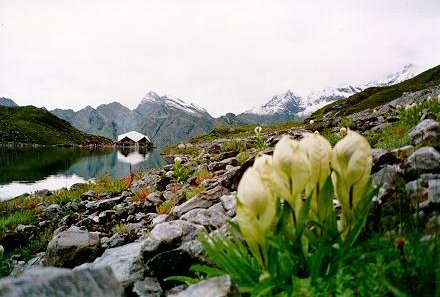
The base for both the Valley of Flowers and Hemkund Sahib is Ghangharia, a small and neat hamlet at the bifurcation of the path. It is from here that people make day trips to the two destinations. Hemkund Sahib nestles high up next to an alpine lake, over 16000 feet in elevation. At these lofty heights, blooms the wondrous Brahma Kamal, the national flower of Uttarakhand. A rare flower that blooms only in certain regions, the Brahma Kamal needs protection. There is a strong ban on plucking these flowers on the entire route to Hemkund (these flowers actually are only spotted when very close to the shrine). Despite a thick fog and incessant drizzle, on our trek up to the shrine we saw these signs clearly all the way up and into the shrine as well. It is truly a beautiful flower [See Picture Below]


While trekking in the Valley of Flowers our group met up and chatted with many other groups. This is a tale I heard from them.

"We are a big group from Delhi. We are here to visit all the pilgrimages in this area. Hemkund was beautiful yesterday. We had clear skies and could see for miles. Have you heard of the Brahma Kamals? They bloom only in this region. We saw them yesterday. They are beautiful. But you cannot pluck them. You know, it is the month of saawan (monsoons) and one gentleman of our group, poor fellow did not know, so he plucked six (yes six!) of them and offered them at the shrine since it is custom to offers flowers in saawan. Once the prayer ceremony got over, the priests announced on the public address system that a serious offence has been committed. The fine for each flower is 500 Rs. I don't know how they managed to trace the culprit and demanded we pay 3000 Rs. It took us a lot of pacifying to get out of that situation. So be careful don't offer Brahma Kamals at the shrine. They create too many problems otherwise"

My thoughts after hearing the tale were like this

- **They** create problems??

- Good for the priests(and Nanda Devi conservation committee). I am glad they made an issue out of it.

- Bad for the priests (and Nanda Devi conservation committee). Why did they let him go?.

My friend's take on this was - If the fine for plucking one flower is 500 Rs then 6 flowers should amount to 50,000 Rs. The fine should not grow as a linear equation.

My suggestion. Too less. We need to make examples of cases like these. Twist his ears as hard mom twisted yours. Just don't let him go back. Have him stay back in Hemkund sahib plant six Brahma Kamal bulbs on those rocky cliffs. Let him leave only after he has managed to produce six healthy budding Brahma Kamals to show as his exit pass........blooming idiot!


Wednesday, June 4, 2008

Opinion: 'De-Saintising' Politics

There is a marked double standard that all Americans practice when it comes to their public figures. For a society that does not think twice before filing for divorce, isn't it strange that politicians don't have a chance to a public office if they have been divorced?

So, it is official now Obama is the winner of the democratic race. Hillary Clinton heads towards accepting the vice-president nominee slot. A historic bid for the white-house comes to an end (I know not the white-house just as yet, but as intense if not more).

The results don't surprise me. Clinton's tenacity in the last leg does - mildly. Over the frenzy of the democratic race of the past few months one thing has become quite apparent, this historic battle was not purely about race, gender and creed as it was pitched to be. It was as much about the attitudes, aspirations and prejudices that survive and thrive in what is considered by many to be one of the most progressive democracies in the world.

Lets talk of prejudices first. Extensive grass-root survey on why not him? or why not her? has yielded some interesting insight. Mind you, this is not the informed, analytical opinion that rests on the understanding of Obama's excellent speeches or Clinton's impressive track record. This is the 'tabloid fodder' opinion that usually makes or breaks a campaign.

Why Not Him: He is inexperienced. Has no clue of the travails of the white-house. You would not like to wake him up with the 3AM call. His wife is not proud to be an American. He thinks all Pennsylvanians are gun-totting red necks...
Why Not Her: She is manipulative. She is power-hungry. She is will do anything to be president. She stood by her husband despite the Lewinsky Scandal. She preferred to spend mother's day campaigning instead of spending it with her daughter (refer to power hungry). She is as superficial as Aishwarya Rai, her smile does not reach her eyes (our desis have an opinion too :))

Do you see a pattern emerge there? If Clinton was a man, would any one of those points genuinely count? Why is being power hungry considered a sin for a woman and ambition for a man? Why would you blame a woman for standing by her errant husband. Should one not praise the strength of her character? Prejudices are things that laws can only reign in, never fix. So they will remain. What emerges in this case is that in the US it is far easier to be anti-woman than be anti-black.

And that takes me to the second part of my observation on attitudes and aspirations. These attitudes might be prevalent world over, but they emerge very strongly in US politics. There is a marked double standard that all Americans practice when it comes to their public figures. For a society that does not think twice before filing for divorce, isn't it strange that politicians don't have a chance to a public office if they have been divorced?

Bill Clinton was in the dog-house for having an affair while in office. If that was a criteria for losing a job a large chunk of the population world-over would be jobless. OK, so it was not so much about having an affair, but getting caught in the act right? So you are basically impeaching him for being stupid? I am told it's not even that, it's lying under oath. Point taken, but what is more harmful a lie, Clinton declaring under oath that he did not have an affair(normal human reaction for anyone caught with their pants down) or Bush declaring with conviction 'There are weapons of mass destruction in Iraq'? Should we have not impeached Bush for not only leading the country on a wild goose chase but also for murdering a country and sacrificing so many American lives in the process? Has he not failed in his job as president as opposed to Clinton whose failure was more personal in nature? To me Clinton deserved a hard knock on the knuckles (mainly for using the white-house for his pursuits, if he had done what he did outside.. none of our business) and Bush impeachment.

If you look around, Clinton was not the only one with a roving eye. JFK had an affair with Marilyn Monroe. Look at the French. They have no problems what-so-ever :). The French ofcourse never had any puritanical pretences but, closer to home in India, Nehru was a known womaniser, but our nation continued to revere him. And the less we say about 'Mahatma' Gandhi's experiments with celibacy the better. Yet, it is Clinton who has made history in this respect. The generation of Americans that turned a blind-eye to JFKs distractions has long given way to the far more demanding modern American. An American who expects his leaders to stand by all those values that he himself discarded long ago.

Which takes me to the moot point of this piece. In this era of specialisations, is it practical for us to expect our politicians and heads of state of be sarv guna samppan- impeccable human beings in all aspects?. We all have human failings. How can we expect our leader to have none? Isn't that too lofty an ideal to aspire for? A man could be a bastard in real life, yet run the country with honesty, integrity and acumen that makes a good president. On the other hand another human being could be the perfect family man, yet be corrupt, ineffectual and weak. A politician's job is to run the country. Period. And as long as he does that job well and keeps to the laws of the land shouldn't we mind our own business?

I know the halo around Obama's head as just got stronger, but now it is the time to remove that halo, to conquer the need for seeking an aura. Time has come to de-saintise politics.

An edited verision of the article resides here : http://desicritics.org/2008/06/05/023322.php